
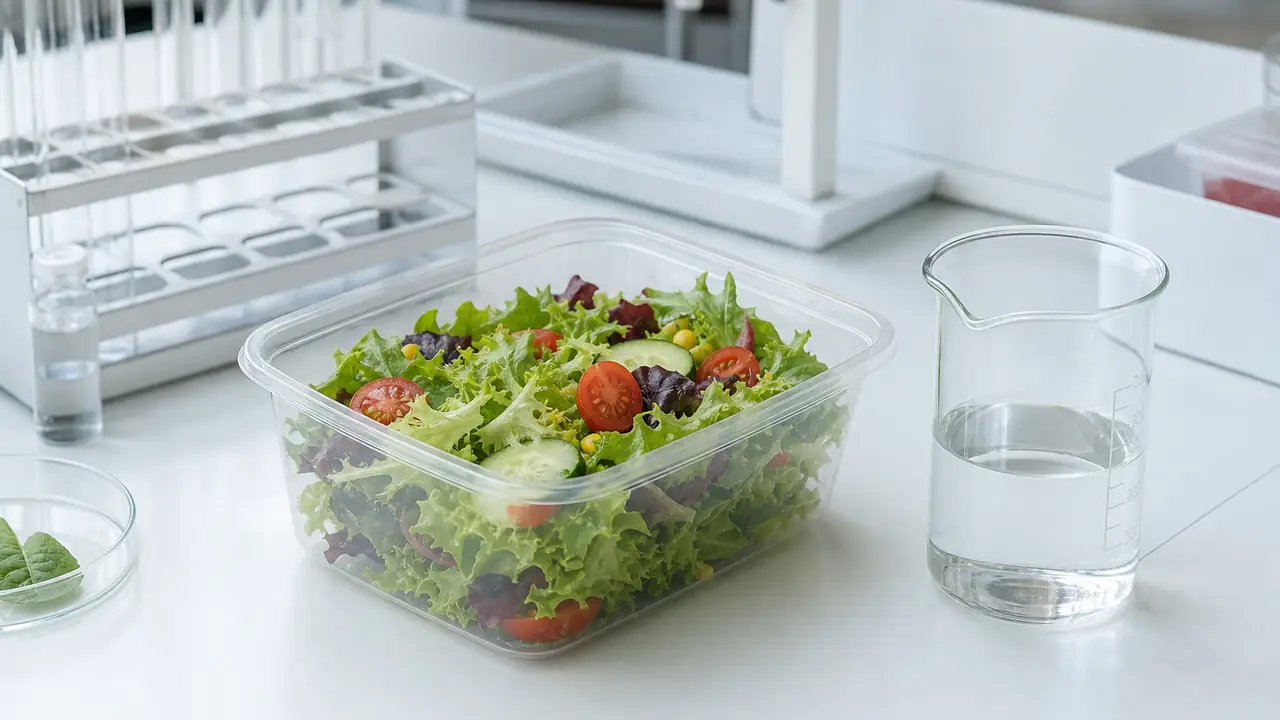
Two ends of the same specification
A container specification usually talks about heat, because heat is where shapes change. Cold matters just as much. A lid that snaps on at room temperature can crack when it is pressed down on a frozen tray. A thin PP wall that is flexible at the counter becomes stiffer in the freezer and less tolerant of a drop. A hot-filled soup cup sees its highest temperature in the first seconds, before the lid goes on. The specification has to cover the whole path the container travels: filling, sealing, chilling or freezing, transport, storage and reheating.
Write that path into the brief as a list of steps with a temperature next to each one. It is the single most useful thing a buyer can send, because it tells the partner plant which grade, wall and lid design to propose and tells the desk which checks to run.
How the main materials behave
PP is the default for hot food. Its melting point is in the 160-180 C range cited in the 21 CFR 177.1520 specifications, which is far above any hot fill, but a container softens well before it melts, and the shape is what matters. PP is also the material most used for freezing, with one caveat: some PP grades become brittle in deep cold, so the lid and thin hinges need checking. PET gives the best clarity and is used cold, for chilled display and refrigerated fruit; it is not used for hot fill or reheating. Paper boxes depend on the coating and the board grade, and moisture from frozen food can weaken the board.
| Material | Hot fill | Freezer | What to check |
|---|---|---|---|
| PP base | Per supplier statement | Per supplier statement | Distortion when hot; drop after freezing |
| PP lid | Fitted after filling | Grade dependent | Opening and closing at -18 C |
| PET clamshell or lid | Not used | Chilled use per spec | Clarity, condensation, hinge cracks |
| Starch-PP blend | Per supplier statement | Per supplier statement | Shape and surface after cycling |
| Paperboard | Dry or bakery only | Board and coating dependent | Softening from moisture |
Reading a supplier temperature statement
Partner plants often state a temperature range. One partner plant describes its injection molded PP cups as having a working range of -10 to 120 C and as suitable for boiling water. That is useful information and the desk records it as written: a supplier statement, to be confirmed by test. It is not a rating the desk repeats to end users, and it does not mean every item from the same plant behaves the same way. A thin thermoformed lid and a thick injection molded cup from the same PP family can respond very differently to the same temperature.
Three questions turn a statement into something usable. Which item and which part does it apply to? For how long, and with which food? Was it measured, and by whom? If the answers are missing, the desk treats the range as a starting point and plans the checks below. In the US, the conditions of use in the table of 21 CFR 176.170(c), graded A to H, are the formal way of stating temperature in a declaration; a declaration naming the right condition is worth more than a number in a catalog.
Hot fill in practice
Hot fill is the moment a hot food goes into the container on the line or at the counter. Soups, congee and curries are the typical cases. Reference soup cups from a Guangdong partner plant run from 350 ml at 116x99x45 mm to 950 ml at 117x82x141 mm; tall cups like the 950 ml model hold a deep column of hot liquid, so the base and lower wall carry the most heat for the longest time. Round tubs from 1,250 ml at 31 g to 2,000 ml at 37.7 g are used for family portions.
The things that go wrong are predictable: the wall bows outward, the rim moves so the lid does not seat, or steam under a closed lid lifts it in the delivery bag. The fixes are also predictable. Hold the gram weight of the reference model, leave a gap below the brim, let steam escape for a moment before closing and check the lid fit on a hot-filled sample, not an empty one.
Freezer and thaw cycles
Freezing adds three stresses. The food expands as it freezes, pressing on the lid. The material stiffens, so a snap lid needs more force and more care to open. And condensation on thawing can weaken paper sleeves and labels. Meal prep programs that freeze, thaw and reheat put a container through all three in one week, and a reusable container goes through them many times.
The working test plan for freezer use is a standard part of the desk test menu, with counts and pass criteria confirmed per order:
- Fill to the fill line with a water-based test food and close the lid.
- Freeze at -18 C for the agreed time.
- Open and close the lid while frozen and check for cracks at the corners and hinge.
- Drop the frozen, filled container from the agreed height.
- Thaw, reheat where the item is marked for the microwave, and recheck the lid fit.
The details of each check are on testing and inspection. If lids fail at step 3, the lid cracking note sets out the usual causes: grade, wall thickness and fit.
Matching the range to the program
Different programs stress different ends. A restaurant takeout program needs hot fill and short reheats, rarely freezing. A meal prep brand needs all three, and its customers will reheat in the microwave. A supermarket fruit program is cold only, which is why clear PET fits it. The meal prep and delivery page sets out the heaviest case. For reheating, see microwave use and containers.
Stock PP models from the PP food containers line can be sampled in 3-7 working days, so the freezer and hot-fill checks can run before any bulk order; quantities and lead times are on MOQ and lead time, confirmed in writing per program.