
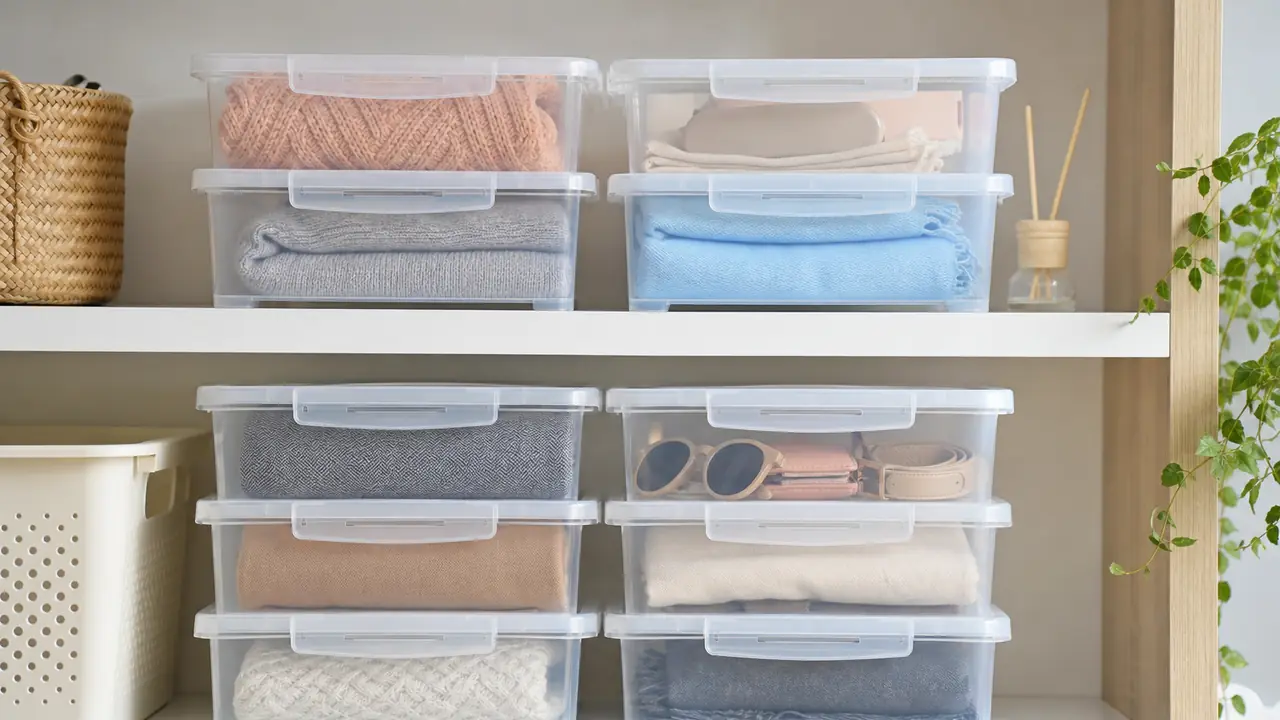
What a collapsible box has to do
A collapsible box is a rigid crate when open and a flat panel when folded. It has to carry a load while open, lock its walls so they do not fold under that load, and fold down without tools when empty. Every one of those functions sits in the hinges and the locking points between the base and the walls. A box can look good in a photo and still fail in the second month of use if the hinge whitens, cracks or loosens after repeated folding.
Lidwell has no partner plant reference model for this line yet. The sizes below are public listing reference sizes used to describe the category and confirmed against a physical sample before an order. A common 30 L folding crate is listed at 17.3x13x9.1 inches, about 440x330x230 mm, folding to about 47 mm. A 45 L format is about 525x355x300 mm. Folded heights across the category typically run 4-9 cm, and inner dimensions are about 2-4 cm smaller than outer dimensions.
Three hinge types
| Hinge type | How it is made | Strengths | Watch points |
|---|---|---|---|
| Living hinge | Thin web of PP molded in one piece with wall and base | No assembly, no loose parts, low cost per piece | Web thickness and flow direction decide durability |
| Pin or snap hinge | Separate wall and base parts clipped on molded pins | Walls can be replaced, stiffer frame | Pins can wear or pull out; assembly step adds a check |
| Soft fold (silicone or TPE band) | Flexible band joining rigid PP sections | Very low folded height | Band material and bonding need their own tests |
Most collapsible crates in the category use PP with either living hinges or clip-on pin hinges. PP is the material of choice because it bends many times without cracking when the hinge is designed correctly, which few other common plastics do.
Living hinges: why PP and why flow matters
A living hinge is a thin strip of plastic that bends instead of a joint. PP suits it because its molecules align across the hinge during molding and give a strip that can be folded again and again. That alignment only happens if the melt flows across the hinge, not along it, which is a mold design decision: gate position and wall layout set the flow direction. A hinge that fills from the side is weaker than one the melt crosses at right angles. Ask the plant how the mold fills the hinge and whether the first folds are made while the part is still warm from the press, a step many plants use to set the hinge.
Web thickness is the other variable. Too thick and the hinge whitens and cracks when folded; too thin and it tears under load. The right value depends on the grade and the design, so it is agreed with the plant on the sample, not copied from another product. The injection molding page explains gates and flow.
Pin hinges and locking points
Pin hinges join separately molded walls to the base. They make a stiffer box and allow a damaged wall to be replaced, but they add an assembly step and a new failure point: a pin that is too short or a socket that is too open lets the wall pull out under load. The locking points matter as much as the hinges. When a box is open, the walls are held upright by clips at the corners. If the clips are too weak the box folds under a load from above; if they are too strong the customer cannot fold it. Ask for the force needed to release the corner clips to be checked on the sample and written down.
Fold cycle life: how to test it
No public standard sets a fold cycle count for household folding crates, so the number is agreed between buyer and plant. The desk sets a stated working default for each program and confirms it in writing per order. A useful fold test looks like this:
- Take boxes from the T1 trial or from the production lot, not hand-picked pieces.
- Fold and unfold each box the agreed number of times, by hand or on a simple fixture.
- Repeat on boxes conditioned cold, since PP is less flexible at low temperatures.
- Inspect each hinge for whitening, cracks and loosening, and check that the clips still lock.
- Load the open box from above with the agreed stack and confirm the walls hold.
Describe the result as passing the agreed fold test, not with a promise about years of use.
Folded height and the carton
The selling point is space saved, and the folded height is the figure buyers compare. A 30 L crate that folds to about 47 mm takes a fraction of its open volume in storage and in freight. Lower folded height usually means thinner walls or more fold lines, which both put more demand on the hinge, so the target folded height and the fold test belong in the same discussion. On the carton side, folded crates ship flat and stack like panels, which makes them efficient to load; the packaging and palletizing page shows how to plan cartons by folded height.
Lids, handles and the range
Some folding boxes carry a lid that also folds or that sits on top and makes the boxes stackable. Handles are molded into the short walls. Both should be in the specification: lid type, whether it locks, handle shape and the material of every part. Ranges usually combine two or three sizes on related footprints so that boxes stack together. See collapsible vs rigid storage boxes for when a rigid box is the better buy.
Sourcing and quantities
Folding crates come from injection molding plants in the household plastics clusters of Taizhou and Ningbo, where molds are made close to the presses. Storage lines typically start from 1,000-3,000 pieces per item, depending on size and mold, with custom work typically 15-30 days and new molds 45-60 days for the first order including tooling. These are typical reference ranges, confirmed in writing for each program; see MOQ and lead time, and send the brief through the quote form.