
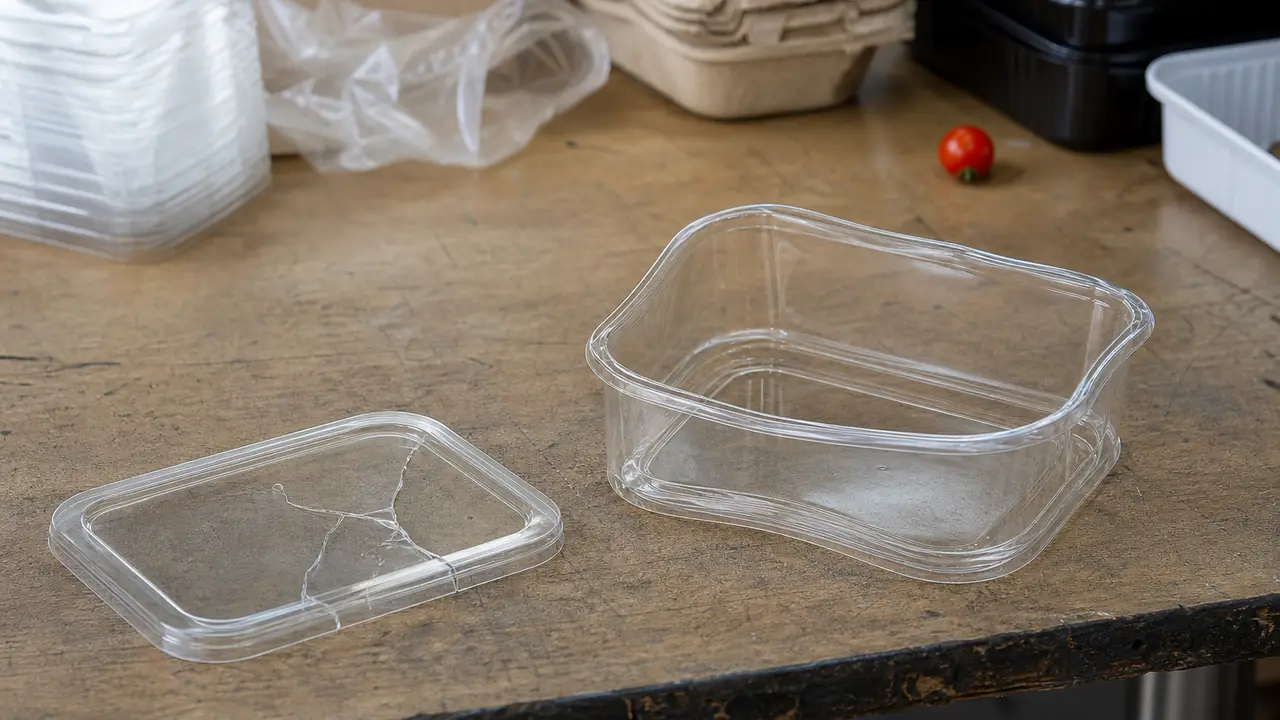
Why clear boxes show every mark
On a colored or frosted box, a fine scratch disappears into the surface. On a clear box, the same scratch catches the light and looks like a defect. Clear storage lines in this range include cosmetic organizers, drawer units, fridge bins, clear shoe boxes, PET fruit boxes and clear folding boxes for gifts. A reference drawer organizer from a public listing measures about 318x213x92 mm; a reference clear folding shoe box is about 330x230x140 mm; a reference fridge bin is about 315x157x89 mm. All of them have large flat clear faces, which is exactly where scuffs show.
Because these products are often photographed for listings and placed on retail shelves, buyers notice scuffs quickly, and so do their customers. A clear organizer with visible scratches is usually returned even when it works perfectly.
Which clear materials scratch most easily
Clear materials differ in surface hardness and in how scratches look. PS, the common material for clear organizers and drawer units, is very clear and rigid but has a relatively soft surface and marks easily when parts rub together. Acrylic (PMMA) has a harder surface and better scratch resistance than PS, and it is more costly. PET, used for fridge bins, fruit boxes and some organizers, is tough and clear and marks less obviously than PS. PP can be made fairly clear but is softer still; it tends to show scuffing as a haze rather than a sharp scratch. Clear PVC appears in soft folding boxes and in small item storage packaging only, and it also marks if sheets rub in transit.
The choice is a trade-off between clarity, scratch resistance, impact strength and cost. The cosmetic organizers page and the container materials page compare the options; the material of each part is named on the order.
Where scratches come from
At the mold
The surface of a clear part copies the surface of the mold. A worn or poorly polished cavity produces fine lines and haze on every part. Ejector marks and drag marks on side walls, where the part scrapes the mold as it is pushed out, show up as streaks. These are mold issues, and they repeat on every part from the same cavity, which is how they can be identified. Draft angle and mold polish are covered on injection molding.
On the packing table
Parts dropped onto a conveyor, stacked face to face without protection or slid across a rough table pick up scuffs within seconds. Gloves with grit on them leave marks; so does wiping dust off a dry surface with a rough cloth.
In the carton
Transit vibration is the biggest source. Parts that can move against each other in a carton rub for weeks. Nested clear bins, drawers loose inside a frame and lids stacked face to face are the usual victims. Dust inside the carton acts as an abrasive. Static attracts that dust, which is one reason scratch and dust problems often appear together; see static and dust on plastic boxes.
Protection options
Peelable protective film on the main clear faces is the most effective step for acrylic and premium PS organizers, and it is common for display pieces. Poly bags for each unit stop parts rubbing against each other. Interleaving sheets of soft paper or foam between nested bins reduce contact. Drawer units can be shipped with drawers fixed or wrapped so they do not slide. Carton dividers keep units apart. Each step adds cost and packing time, so the desk proposes the lightest combination that solves the problem for the product and the sales channel.
Retail and marketplace programs need different packing. A retail box with a window needs the product to look perfect through the window; a marketplace parcel needs the unit to survive single-parcel handling. The packaging and palletizing page covers both.
Design choices that hide or reduce marks
Some scratch problems are better solved in the design than in the carton. A light texture or frosted finish on the base, the back wall or the underside of a lid hides handling marks while keeping the front face clear for display. Small feet or raised ribs on the underside of a bin lift the clear base off shelves and off the part below in a stack, so the visible surface never slides on anything. Rounded edges catch less on packing tables than sharp ones. Drawer units with a slight stop or a snug runner rattle less in transit and rub less against the frame. These details are decided when the mold is designed, so they are worth raising before tooling starts on a custom line rather than after the first complaint. On stock molds, the desk compares the available models with these points in mind.
Diagnosis table
| Symptom | Likely cause | Check | Fix |
|---|---|---|---|
| Same lines on every part | Worn or poorly polished cavity | Compare parts from one cavity | Mold repolish or cavity repair |
| Streaks on side walls | Drag during ejection, low draft | Inspect parts straight from the machine | Mold adjustment, draft review |
| Random scuffs on flat faces | Rubbing in carton during transit | Open cartons, check for movement | Poly bags, film, dividers |
| Fine haze on PP or PS | Abrasive dust and handling | Check packing area cleanliness | Clean packing, soft gloves, film |
| Scratches on nested bins only | Bins rub where they nest | Inspect contact points | Interleaving sheets, looser nesting |
| Scratches appear after wiping | Dry wiping of dusty surface | Ask how dust is removed | Anti-static packing, no dry wiping |
What to put in the order
- Name the clear material of every part, including lids and drawers.
- Define cosmetic grades for visible faces: what counts as a defect and at what viewing distance.
- Specify protective film, poly bags and interleaving for each unit.
- Ask for a carton drop and vibration check on the packed sample where the channel is parcel shipping.
- Include a cosmetic check on random cartons at pre-shipment inspection.
Defect limits and sample counts are a stated working default and are confirmed per order. See quality control for how cosmetic defects are graded.
Next step
Organizer and storage lines typically start at 1,000-3,000 pieces per item depending on size and mold, confirmed in writing per program; see MOQ and lead time. To review a current scratch problem, send photos and the packing method through the quote form.