
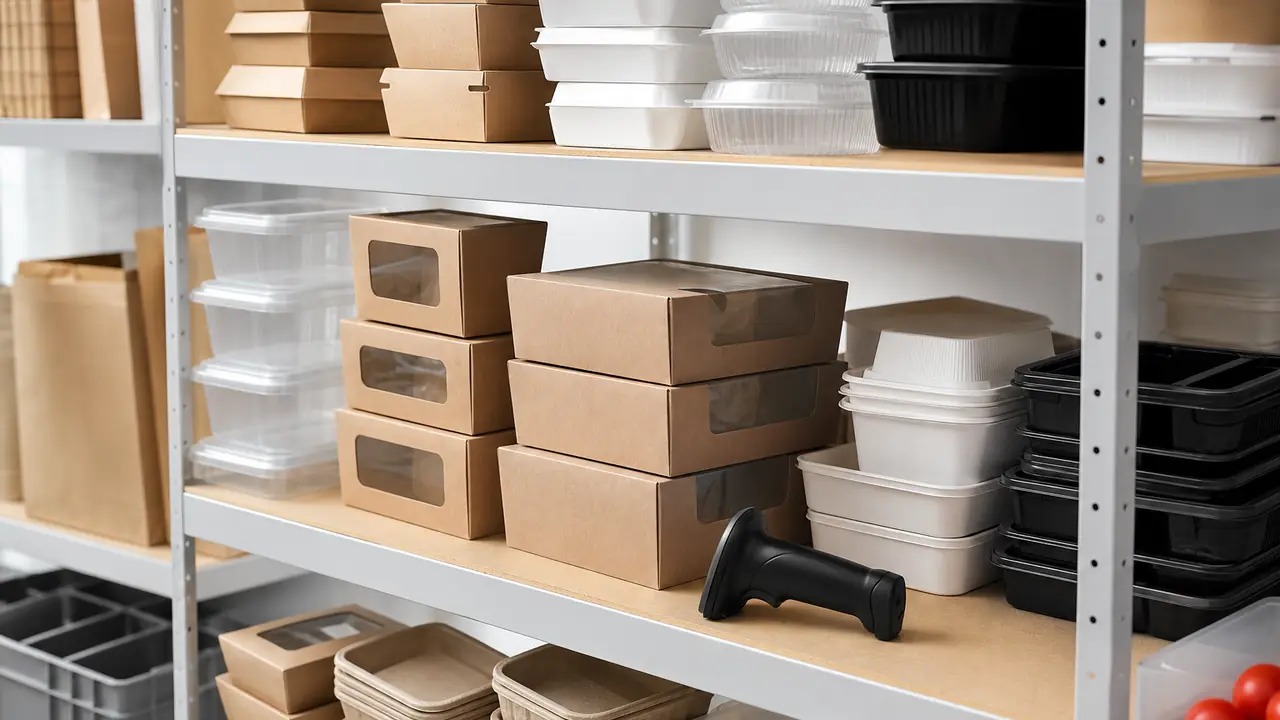
What a meal prep container has to survive
A takeout box lives for about an hour. A meal prep container lives for days: filled in a production kitchen, sealed, chilled or frozen, stacked in a cold room, packed in an insulated box, stored in a customer's fridge and finally reheated. At every stage something can go wrong. Lids crack in the cold, rims deform when stacked, sauces travel between compartments, and a container that was never meant for the microwave warps in it.
Because the customer opens the meal at home, the container is also the brand's most frequent physical contact with that customer. A lid that has to be forced, or that pops open in the bag, is remembered more than the recipe.
Portions decide sizes
Meal prep brands sell portions: a standard meal, a high-protein meal, a light lunch, a snack. Each portion maps to a capacity, and the capacities should sit on as few footprints as possible so one lid and one sealing setup serve several products. The reference rectangular PP series from a partner plant in Huizhou, Guangdong, runs four depths on one 170x115 mm footprint:
| Portion | Container | Outer size | Gram weight |
|---|---|---|---|
| Snack or side | 500 ml rectangular | 170x115x34 mm | 17 g |
| Light meal | 650 ml rectangular | 170x115x43 mm | 18.3 g |
| Standard meal | 750 ml rectangular | 170x115x51 mm | 19.6 g |
| Large meal | 1,000 ml rectangular | 170x115x64 mm | 22 g |
| Set meal, separated | Three-compartment tray | 218x188x42 mm, 1,000 ml | Per spec sheet |
| Bowl meal | Round bowl | 360-1,000 ml, to 140x94x84 mm | 7.3-14.7 g |
Capacities are usually brim-full. Plan portions on the fill line, leaving headspace so the lid seats without touching food; see capacity, ml and oz.
Compartments or one cavity
Divided trays keep rice away from sauce and vegetables away from protein, which keeps textures right after a day in the fridge. The cost is a larger footprint and more complex lid fit: every divider has to meet the lid closely or sauce will travel between compartments. A partner plant's clear PP divided series runs from three compartments at 218x188x42 mm and 1,000 ml up to five compartments at 232x232x47 mm and 1,500 ml, with "Microwave safe" embossed on the lid by the supplier. Single-cavity boxes are simpler and stack more tightly. Many brands use both: divided trays for set meals, single boxes for bowls and mains. See divided containers.
Material: PP for the cold-to-hot cycle
The cold-to-hot cycle is why meal prep containers are PP. PP holds its shape with hot food and tolerates the microwave where the supplier marking allows it, usually with the lid removed or vented. PET gives a clearer lid but is used cold only, so a PET lid on a PP base must be removed before reheating, and the label must say so. Black PP bases with clear PP lids are popular for presentation. Material wording on the pack should follow the supplier declaration, for example made with food contact grade PP per supplier declaration, with documents to FDA 21 CFR 177.1520 for the US or EU 10/2011 for Europe, verified per project.
Freezing is the other half of the cycle. PP can become more brittle in deep cold, and thin lids crack when flexed straight from the freezer. The sample plan should include opening and closing after a freezer hold at -18 degrees C, then a microwave heating test per the marking.
Lids: fit, sealing and branding
- Snap lids suit brands that pack by hand. Opening force should be checked so the lid holds in the bag yet opens without cracking.
- Film sealing suits brands with a sealing machine; the container rim must match the sealing tool, so rim dimensions are fixed in the spec.
- Branded lids carry the logo across every depth on the footprint. Printed lids typically start at 10,000-50,000 pieces per item, confirmed in writing per program.
- Leak checks. For saucy meals, run a tilt and inversion test agreed per order; results are described as leak-resistant in that test, confirmed per order.
The closure types are compared in lid types for food containers.
The test plan for meal prep
- Dimensions and gram weight against the cut sheet.
- Lid opening force and fit on every depth that shares the lid.
- Tilt and inversion test with a representative sauce.
- Freezer hold at -18 degrees C, then opening and closing.
- Microwave heating test per the supplier marking, lid removed where marked.
- Stacking and carton compression for the cold room.
- Migration testing at a third-party lab for the destination market.
Test counts and pass criteria are a stated working default and confirmed per order. See testing and inspection.
Claims on the pack
Meal prep customers read the container label closely, and the claims on it should rest on documents. Microwave and freezer statements follow the supplier marking and the sample tests. Material statements follow the supplier declaration. Avoid unqualified green wording: if a brand wants to talk about lower plastic content, starch-PP blend bowls can carry that statement, but biodegradable or compostable wording is only used where the exact item is certified to EN 13432 or ASTM D6400, and qualified as the FTC Green Guides require. The resin identification code on the base, 5 for PP, should match what the label says about recycling, and recycling statements should be checked against the facilities available in the market.
Launch and reorder
New meal prep brands usually start from stock molds: a few mixed cartons per item, samples in 3-7 working days, and stock orders in 7-15 days. Branded lids add 7-15 working days for a printed sample and 15-30 days for the printed order. A custom mold only makes sense once volumes are stable, typically from 50,000-100,000 pieces per item, with 45-60 days for the first order including the mold. All quantities are confirmed in writing for each program. The use case is described on meal prep and delivery, and the channel view for direct brands on DTC brands.
Send your portions, menu and weekly volumes through the quote form; the desk returns matching reference models with sizes, weights and a test plan.