
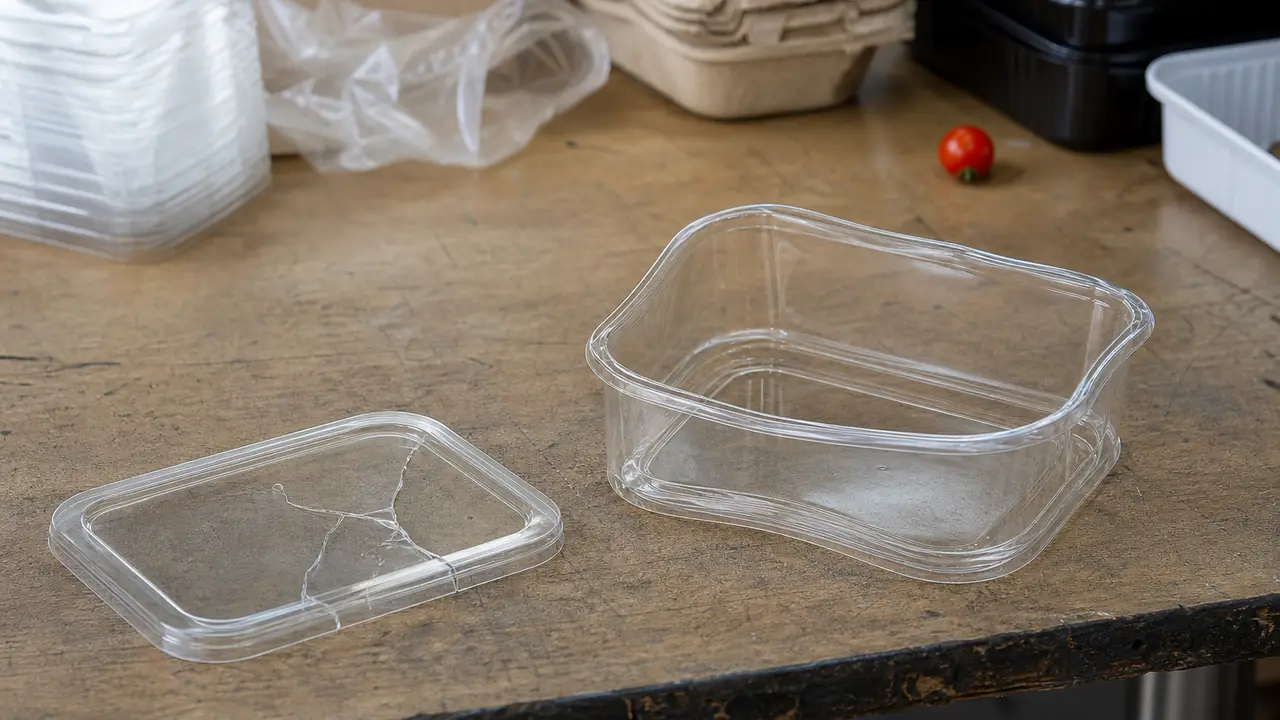
Why plastic attracts dust
Plastics are electrical insulators. When two surfaces rub and then separate, electrons move from one to the other and the charge stays where it lands, because it has nowhere to go. A charged plastic surface pulls in dust, fibres and tiny flakes of plastic from the air around it. Clear and dark parts show it most: dust on a clear organizer or a black-base takeout box is visible from across the room.
Charge builds at several moments in a part's life: when it is ejected from the mold, when it slides down a chute or conveyor, when protective film is peeled off or applied, when parts are pulled out of a nested stack and when poly bags are opened. Dry air makes it worse, because moisture in the air normally lets the charge leak away slowly. In a dry winter or an air-conditioned warehouse the same box will hold its charge for much longer.
Where the dust comes from
Static only attracts what is in the air. A packing area next to grinding, trimming or carton cutting has plenty of fine particles. Thermoformed parts are trimmed from a sheet, and the trimming can leave small flakes along the edge that cling to the part and to its neighbours. Cardboard cartons shed fibres when they are cut and folded. Some of the dust a buyer sees is therefore plant dust, some is carton dust and some is picked up later in the buyer's own warehouse when the cartons are opened.
For food containers this matters beyond appearance. Food contact parts should be packed in a clean area, covered quickly and kept covered; the cleanliness and packing hygiene note covers the basics.
Fixes on the line
Clean air and clean surfaces
The simplest fix is to keep dust away from the parts. Packing tables away from trimming and carton work, regular cleaning, covered conveyors and closed bins for finished parts make a large difference at little cost. Trimming should leave a clean edge; flakes along a thermoformed rim usually mean a worn trim tool, which the plant can sharpen or replace.
Ionizing air
Many plants use ionizing air bars or blowers at the ejection point or over the packing table. They neutralize charge on the part surface so dust does not stick, and a short blast removes loose particles. They are standard on many clear part lines and worth asking about for organizers and display pieces.
Humidity
Very dry packing rooms build more charge. Some plants manage humidity in winter. It is not always practical, but it is worth knowing when complaints come from one season only.
Dust at the buyer's end
Not every dust complaint starts at the plant. Cartons opened in a busy warehouse, parts unpacked and left on open shelves, or display units assembled in a dusty stock room collect dust within hours, and static makes it stick. Marketplace sellers who repack units into their own parcels add another handling step where charge builds. Keep parts in their bags until they are used or displayed, open cartons in a clean area and avoid sliding clear units across each other when restocking shelves. If a retailer reports dust, ask whether the units were displayed out of their bags and for how long before assuming a plant problem.
Fixes in the packing
The packing material can either help or hurt. Ordinary poly bags and film can generate charge themselves when they are pulled over the part. Anti-static poly bags and anti-static film are available and are a common upgrade for clear organizers and storage boxes. Nested takeout containers should be sleeved in bags and closed promptly, rather than left open on a table. Cartons should be closed and taped as soon as they are packed. Paper interleaving sheets can shed fibres; soft foam or anti-static sheets are cleaner where interleaving is needed.
The packaging and palletizing page lists the usual bag, sleeve and carton options.
Anti-static additives
Plants can add an anti-static additive to the resin through a masterbatch. The additive migrates slowly to the surface and lets charge leak away. It is effective for storage and organizer lines. For food contact parts it is a different decision: any additive in a food contact container has to be suitable for that use under the rules of the target market, such as FDA 21 CFR 174-178 or EU 10/2011, and it has to be named on the supplier declaration and covered by the migration test where one is done. The desk does not add an additive to a food container without that documentation. The additives and colorants note explains why.
Diagnosis table
| Symptom | Likely cause | Check | Fix |
|---|---|---|---|
| Fine dust on clear parts out of the carton | Static from ejection and packing | Inspect parts at the packing table | Ionizing air, anti-static bags |
| Plastic flakes along the rim | Worn trim tool on thermoformed parts | Inspect trimmed edges | Sharpen or replace trim tool |
| Carton fibres on parts | Open cartons near carton cutting | Walk the packing area | Separate packing from carton work, bag parts |
| Dust worse in winter | Dry air holds charge longer | Compare complaint dates | Ionizing air, humidity control where possible |
| Dust after peeling film | Film peel creates charge | Peel test in the buyer's setting | Anti-static film or ionized wipe at point of use |
| Storage boxes always dusty | Surface holds charge | Discuss with plant | Anti-static masterbatch for non-food lines |
What to put in the order
- State whether the part is food contact, display or general storage.
- Specify bag type, including anti-static bags where clear faces matter.
- Ask how parts are protected from ejection to carton and whether ionizing air is used.
- For non-food lines, discuss anti-static masterbatch; for food lines, only with documentation.
- Include a cleanliness check on random cartons at pre-shipment inspection.
Defect limits and sample counts are a stated working default and are confirmed per order. See quality control for how cosmetic and cleanliness defects are graded.
Next step
Anti-static bags and film change the packing specification, and sometimes the carton count. Send the current packing method and photos through the quote form; starting quantities and lead times are on MOQ and lead time.