
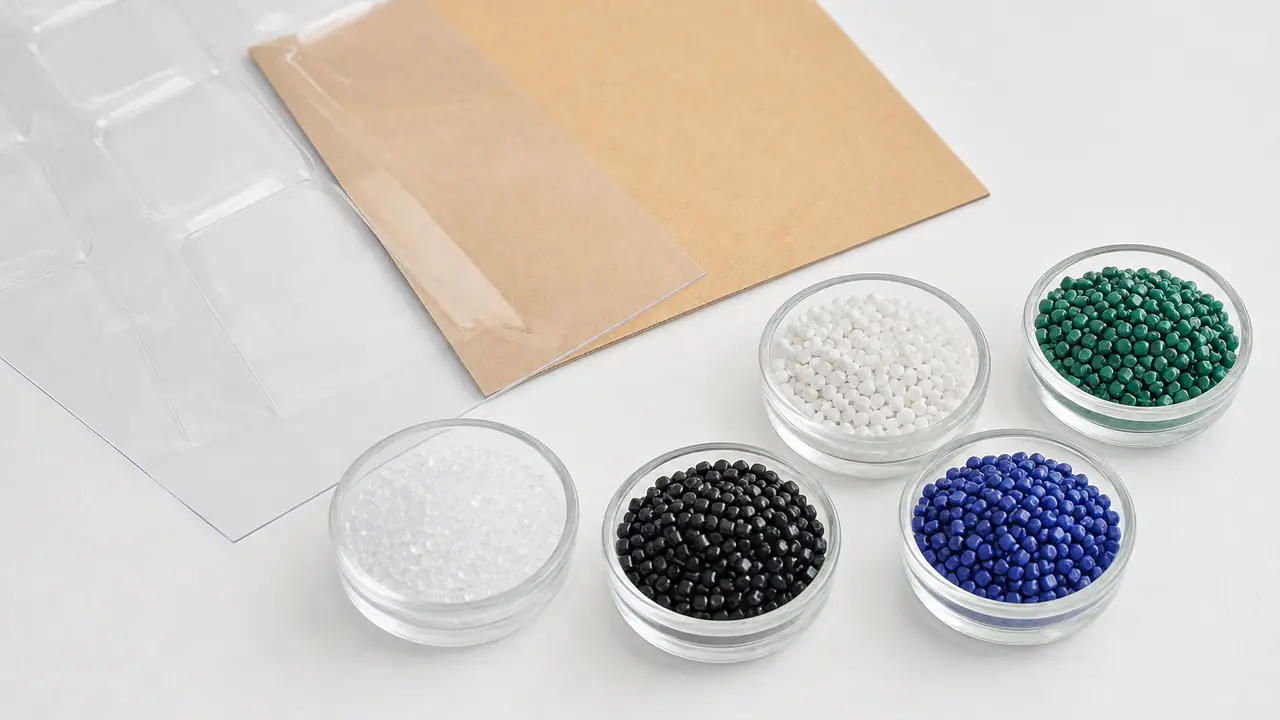
Why additives matter to a buyer
Buyers specify a resin, PP or PET, and assume the container is made of it. In practice the resin arrives with additives already in it, and the plant adds more at the machine: color, processing aids, sometimes fillers. These small additions decide the color a shopper sees, whether nested containers separate cleanly, whether a clear box attracts dust, and how the part behaves in the freezer. They also matter for compliance, because food contact rules apply to the whole finished container, not to the base resin alone.
The main additive families
| Additive | What it does | Where buyers notice it |
|---|---|---|
| Color masterbatch | Pigment in a carrier resin, dosed at the machine | Black bases, white tubs, brand colors |
| Clarifier or nucleating agent | Improves clarity and stiffness in PP | Clear PP lids and boxes |
| Slip and antiblock agents | Reduce friction between surfaces | Nested containers that separate cleanly |
| Antistatic agent | Reduces static charge on the surface | Clear boxes that attract less dust |
| Impact modifier | Improves toughness, often at low temperature | Freezer lids, storage boxes |
| Stabilisers | Protect the resin during processing and use | Mostly invisible, part of the resin grade |
| Fillers | Replace part of the polymer, change stiffness | Starch in starch blends, mineral fillers |
Colorants and masterbatch
Most colored containers are made by adding masterbatch, a concentrate of pigment in a carrier resin, to natural resin at the molding or sheet extrusion stage. The standard colors in the partner plant literature for PP takeout containers are clear, black base with a clear lid, and white. Black bases are common for display and hot food because they hide sauce marks and make food look richer. Starch blend containers are cream colored from the starch itself rather than from pigment.
Three points matter for buyers. First, the masterbatch must be suitable for food contact and covered in the declaration: the carrier resin, the pigments and the dose. Second, a custom brand color needs matching against a physical standard and usually a minimum run, because the plant has to purge and stabilise the line. Third, color varies between batches unless the masterbatch, dose and base resin are controlled; see color variation between batches.
Clarifiers in PP
Natural PP is translucent. Clarifying agents reduce the haze and make clear PP lids and boxes look closer to PET, which matters for display. They do not turn PP into PET, and the haze still grows with wall thickness. If a clear PP part looks noticeably better on one quote than another, a clarified grade may be the reason, and it belongs in the specification so that it is not dropped on a reorder. See PP plastic for food containers.
Slip, antiblock and antistatic agents
Nested thin-wall containers can stick together, which slows a busy kitchen and causes complaints from foodservice buyers. Slip and antiblock agents, together with the design of denesting lugs, help them separate. Clear storage boxes and organizers often attract dust through static charge in a warehouse or on a shelf; antistatic agents reduce this, and packing can help further. These additives can migrate to the surface over time by design, which is why they are part of the food contact assessment for food items.
Fillers and blends
Fillers replace part of the polymer with another material. In this range the clearest example is the starch-based container: partner plant literature describes it as corn starch, filed under PP thermoforming, so the desk treats it as a starch and PP blend. Mineral fillers are used in some opaque parts to raise stiffness. A filled part is still a plastic part and is described as such; the filler does not make it biodegradable. See starch-based containers explained.
What the food contact rules expect
In the European Union, Regulation (EU) 10/2011 lists the substances that may be used in plastic food contact materials and sets an overall migration limit of 10 mg/dm2 or 60 mg/kg of food simulant, plus specific migration limits for individual substances. The declaration of compliance for a finished container should therefore cover the additives and colorants actually used, and the migration report should be on the finished, colored part. A declaration from the resin supplier covers an intermediate material, not the container. In the United States, additives and colorants must be permitted for the intended use under FDA 21 CFR 174-178, with the conditions of use matched to the product. For China, GB 4806.7-2023 covers plastic materials and articles, and GB 4806.6 covers resins. Documents are issued to the partner plant or your brand per project and verified by the desk; confirm with your test lab.
Questions to ask the plant
- Which resin grade is used, and does it already contain a clarifier or other additives?
- Which masterbatch is used for each color, at what dose, and is it covered for food contact?
- Are slip, antiblock or antistatic agents added at the machine?
- Is any filler used, and in what share?
- Do the declaration and migration report cover the finished colored part?
- Will the same grades and masterbatch be used on reorders, or will any change be notified in writing?
Keeping the recipe stable
The most common additive problem is not a wrong additive but a changed one: a cheaper masterbatch, a different resin grade or a dropped clarifier on a reorder. The result is a color shift, a hazier lid or containers that stick together, and sometimes a food contact file that no longer matches the product. The desk writes the resin grade, masterbatch and additives into the specification, keeps the approved reference part, and asks for any change to be confirmed in writing. Custom colors typically follow the logo and print minimums, around 10,000-50,000 pieces per item, confirmed per program on MOQ and lead time. Send the colors and parts through the quote form.