
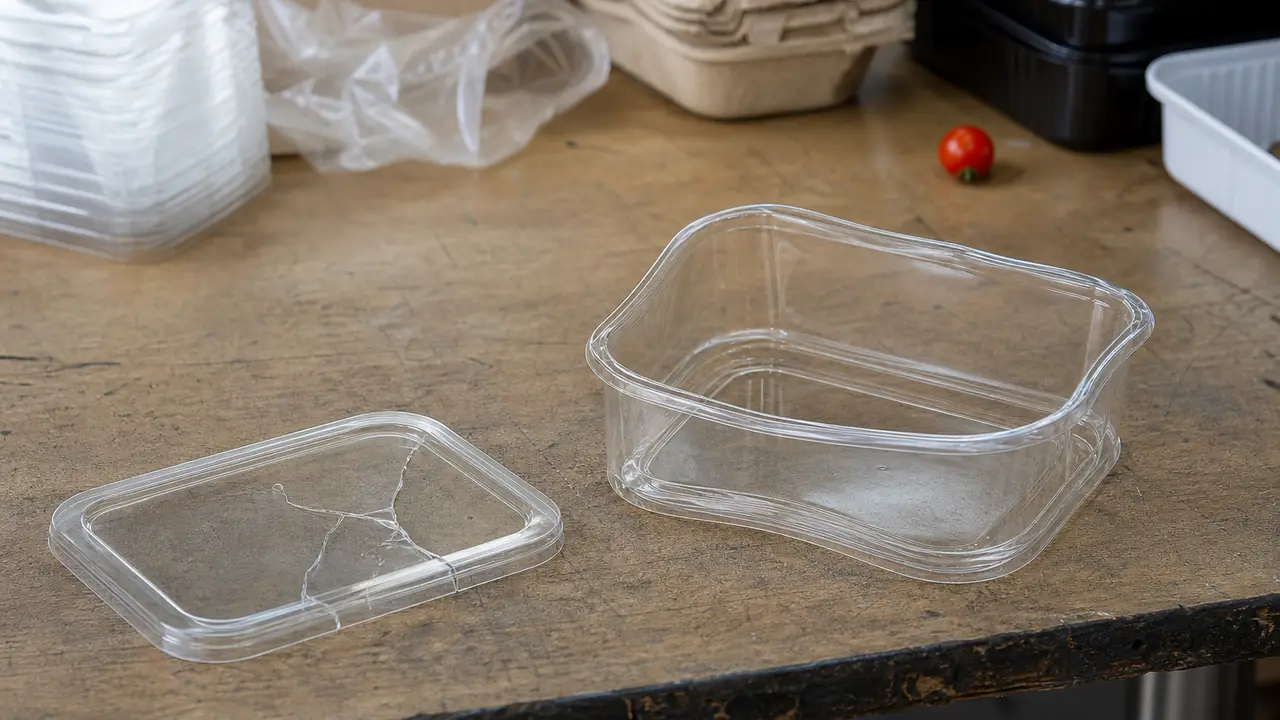
Start with the complaint log
Before changing a supplier or a material, sort the last few months of complaints and returns. For each one, note the product, the batch or date code if known, what the customer said and a photo. Group them by what failed, not by how the customer described it. A short table of fifty complaints usually shows that two or three causes account for most of them. That is where the effort should go.
Across the takeout, food storage and home organizer lines the desk coordinates, the same five causes come up again and again. They are listed below in the order buyers usually meet them.
1. The wrong material for the use
A clear PET clamshell used for hot food, a standard PP lid used in a freezer program, a PS organizer sold for a bathroom where it gets knocked, a PVC window box used for something warm: each of these is a good product used for the wrong job. The fix is to state the use in the order and let the material follow. PP is the usual material for hot food and reheating where the supplier marks it; PET for chilled display and clarity; PVC only in non-heated packaging and storage; PS, acrylic and PET for clear organizers. The container material guide sets out the choices, and the related problem note on warping in heat goes into detail. Cold is the mirror image of heat: lids that flex easily at room temperature can snap when opened straight from a freezer, so frozen storage programs need a grade with better cold impact behaviour, named on the supplier declaration and checked at -18 C on the sample.
2. Lid fit and leaks
Loose lids, tight lids, lids that pop off in a delivery bag and sauce that escapes at the rim are the most common complaint for takeout ranges. The root causes are rim tolerance, lids and bases from different molds or runs, the wrong shape for liquids and overfilling. The fixes are one rim specification for every base that shares a lid, batch matching, round tubs for liquids and a tilt test written into the order. Containers that pass are described as leak-resistant in a standard tilt test, confirmed per order, never with an absolute claim. See leaking takeout containers.
3. Damage in transit
Crushed cartons, cracked lids in the bottom layers, bins pressed oval and nested parts stuck together all start in the container load. Light, bulky goods give their cartons little support, sea transit runs typically 15-25 days to the US West Coast and 30-45 days to Europe, and humidity weakens corrugated board. The fixes are the right board grade, a stated stack height, inner packing and a load plan. See carton crush in transit.
4. Appearance: scratches, dust and color
For storage and organizer lines, appearance is often the largest complaint group. Scratched clear faces, dust clinging to new boxes and lids that no longer match the bins on a reorder lead to returns even when the product works. The fixes sit at the mold, on the packing line and in the color standard: protective film or bags, ionizing air, a physical color standard kept by all parties and notice of any masterbatch change. See the note on color variation between batches; the related notes on scratches and static in this series cover the packing side.
5. Size and description mismatches
Many complaints are not about defects at all. A customer expected a bigger box, a fridge bin does not fit the shelf, a shoe box will not take a large pair, a meal prep container labelled 750 ml holds less food than expected. These come from listings and packaging that state the wrong dimension or an unclear capacity. Outer size is not inner size: for collapsible boxes, for example, inner dimensions are typically 2-4 cm smaller than outer ones. Capacity on a cut sheet is often brim-full volume, not working fill. A reference clear shoe box at about 330x230x140 mm suits shoes up to about 31 cm long and 13 cm high; stating that fit avoids returns from customers with larger shoes. The food container sizing guide covers how to describe sizes, capacities and fill lines so that the listing matches what arrives.
The five causes side by side
| Symptom | Likely cause | Check | Fix |
|---|---|---|---|
| Warping, cracking in use | Material not suited to heat or cold | Use stated against resin and grade | State the use, choose material from it |
| Loose lids, leaks | Rim tolerance, mixed batches, wrong shape | Opening force, tilt test on all depths | One rim spec, batch matching, tilt test in order |
| Crushed cartons, cracked lower layers | Weak board, high stacks, humidity | Stacking and drop checks on packed carton | Board grade, stack limit, inner packing |
| Scratches, dust, off-shade reorders | Mold finish, packing, masterbatch change | Cosmetic check against standard | Film or bags, ionizing air, color standard |
| Smaller than expected, does not fit | Outer size or brim-full capacity in listing | Measure inner size and working fill | State inner size, fill line and fit examples |
Turning the five into the order
- State the use of every item: hot, cold, frozen, reheated, display or storage.
- Name the material of each part and the documents for the destination market.
- Approve a golden sample and record weights, opening force and color.
- Agree the tests: tilt, freezer, heating per supplier marking, carton stacking and drop.
- Specify packing: bags, sleeves, board grade, stack height.
- Check the listing and pack copy against measured inner sizes and working fill.
- Repeat the key checks at pre-shipment inspection.
Test counts and pass criteria are a stated working default and are confirmed per order. Together they form a short checklist that can be reused for every new item and every reorder.
Next step
Most of these fixes cost little when they are written into the first order and a lot when they are added after complaints. Starting quantities and lead times are on MOQ and lead time. Send a complaint summary with photos and the models involved through the quote form and the desk will map the causes and propose changes.