
What distributors usually struggle with
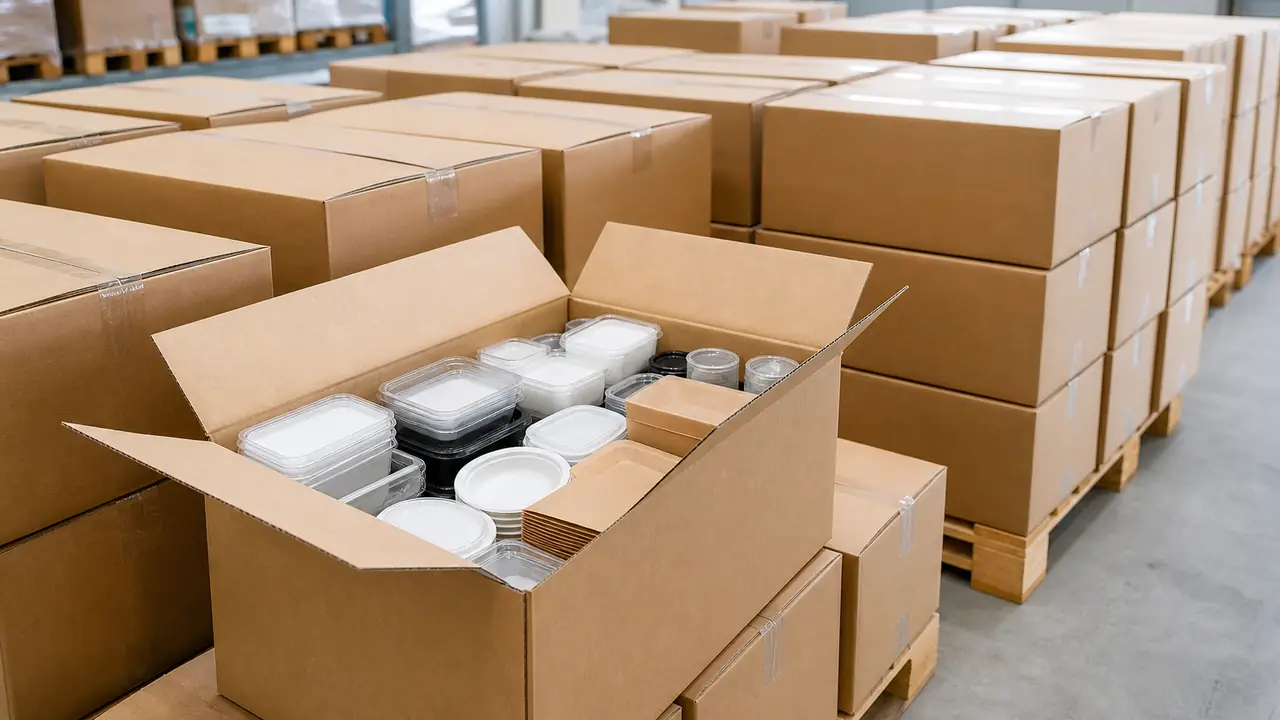
A distributor sells to many customers who each want a different part of the range: a sushi bar wants shallow bowls, a roast-meat shop wants 1,200 ml boxes, a bakery wants kraft boxes with a window. The range has to be complete, or the customer buys the missing size elsewhere and eventually moves the whole account. Replenishment has to be steady, because a distributor carries the stock risk and cannot hold months of every item. And every reorder has to match the last: a lid that fits the January base must fit the June base, the black must be the same black, and the carton count must be the same so the warehouse system stays correct. Batch inconsistency is the quiet problem that loses accounts.
Recommended lines and reference series
| Line | Reference series | Material | Packing |
|---|---|---|---|
| PP rectangular boxes | 500-1,000 ml on 170x115 mm, 17-22 g; 1,200-1,500 ml on 217x149 mm | PP | 200-300 sets per carton |
| PP round tubs and soup cups | Tubs 1,250-2,000 ml; cups 350-950 ml | PP | Cups 200 sets per carton |
| Divided fruit containers | Three to five compartments, 1,000-1,500 ml, 218x188x42 to 232x232x47 mm | Clear PP; PET for cold display | 200 sets per carton |
| Starch-based containers | Round bowls 380-1,000 ml; 800 ml at 175x125x56 mm | Starch blended with PP | 200-300 sets per carton |
| Folding and bakery boxes | 190x85x35, 160x85x35, 135x73x35 mm; click-lock 350-2,880 ml | Kraft or white card, PET or PVC window | Per board grade |
| Storage and organizer lines | Fridge bins, collapsible, shoe, cosmetic and desk boxes | PP, PET, PS, acrylic | Per item |
The table shows why series matter: the 170x115 mm PP footprint carries four capacities under one lid, and the divided trays share a near-common rim class. A distributor that buys by series stocks fewer lids. Starch-based containers are described as starch blended with PP, not as biodegradable unless a named certification applies. See takeaway packaging and food storage.
Quantities and replenishment
Stock molds typically start from 1-10 mixed cartons per item, so a distributor can carry a wide series without a large commitment on slower sizes. Printed items run 10,000-50,000 pieces per item and storage items 1,000-3,000 pieces. Stock production runs 7-15 days, printed 15-30 days. Sea freight to the US West Coast takes about 15-25 days and to Europe about 30-45 days, so a reorder point has to allow for production plus transit. The desk keeps a rolling reorder plan with the partner plants and can split one container load across several series. All figures are typical reference ranges, confirmed in writing for each program.
Documents across a customer base
A distributor answers for every customer, so documents are kept per line and per market: supplier declarations to FDA 21 CFR 177.1520 for PP in the United States; declarations to Regulation 1935/2004 and Regulation (EU) 10/2011 with migration reports for the European Union; GB 4806.7-2023 or GB 4806.8 for paper where China applies. Disposable plastic cutlery and plates have been banned from the EU market under Directive 2019/904 since 3 July 2021, PLA included, so EU distributors take wooden cutlery kits instead. Documents are issued to partner plants per project and verified by the desk.
Checkpoints for batch consistency
- Gram weight per item against the cut sheet on every lot, the clearest sign of wall thickness.
- Lid fit between the new base and retained lids from the previous lot.
- Color against a retained sample; see color variation between batches.
- Carton count and carton marks unchanged unless agreed in writing.
- Tilt test with liquid on tubs and cups, confirmed per order.
An illustrative example
This example is illustrative and anonymous. A regional food packaging distributor wants to add a PP series and kraft bakery boxes. The desk sets up the 170x115 mm series and round tubs from Guangdong partner plants and bakery boxes from the Longgang printing cluster, each item entering from a few cartons. Retained samples from the first lot become the reference for gram weight, color and lid fit, and each reorder is checked against them before it ships.
How to start
Send your current range, monthly volumes, markets and reorder rhythm through the quote form. The desk maps it to reference series and returns a replenishment plan.