
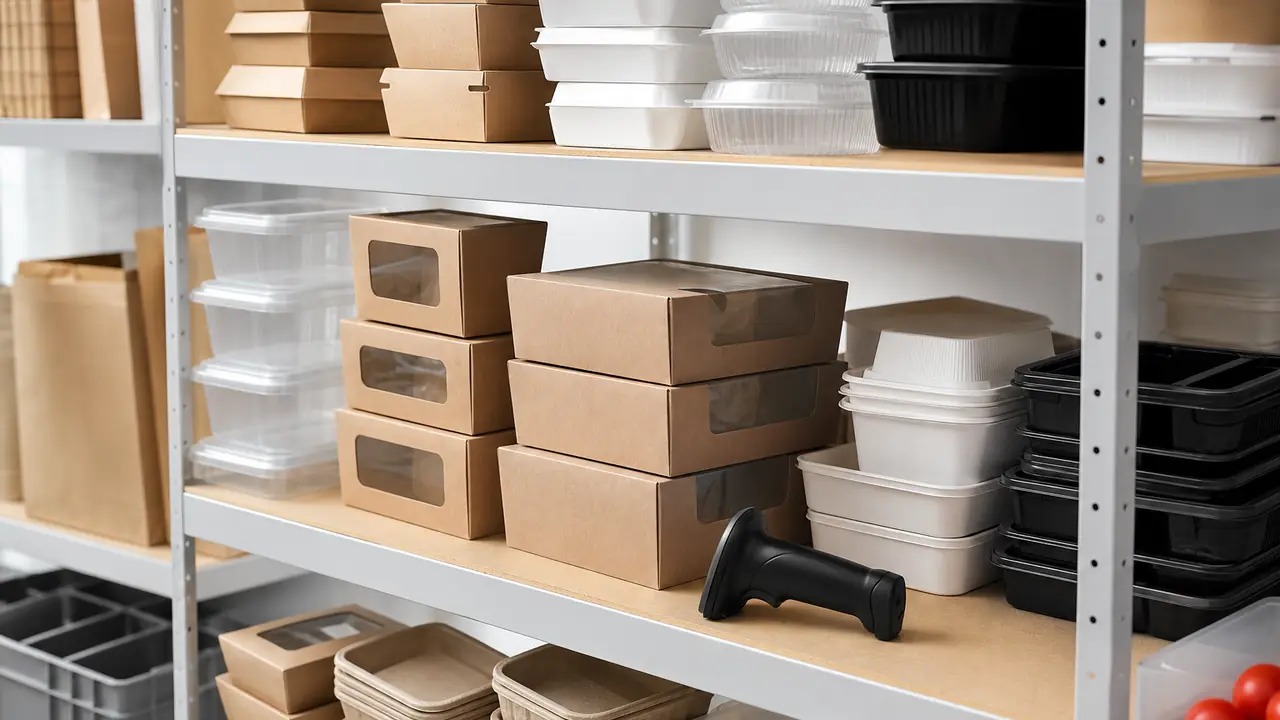
Why packaging is hard to stock
Packaging has three habits that make inventory planning difficult. It is bulky, so stock is expensive to store relative to its value. It has long and variable total lead times, because most of it crosses an ocean. And it is critical: a restaurant without its main container, or a distributor without its fastest-moving size, loses sales immediately. The usual reaction is to order too much of everything. A better reaction is to know the real lead time of each item, set a reorder point from it and keep the range short enough to manage.
The real lead time, order to shelf
The lead time that matters is not the production time quoted by a plant. It is the time from placing an order to having goods available in your warehouse.
| Component | Stock item | Printed or custom item | New mold, first order |
|---|---|---|---|
| Order confirmation and deposit | A few days | A few days | A few days |
| Sample, if needed | 3-7 working days | 7-15 working days | T1 trial about 25-45 days |
| Production | 7-15 days | 15-30 days | 45-60 days including the mold |
| Inspection and loading | A few days | A few days | A few days |
| Ocean freight | 15-25 days to the US West Coast, 30-45 days to Europe | ||
| Customs, inland, receiving | Per market and port | ||
These are typical reference ranges and are confirmed in writing for each program; see MOQ and lead time. For a repeat stock item with no sample, the total is often six to ten weeks to a US warehouse. Printed items add two or more weeks. Seasonal peaks and holidays at origin add more.
Setting a reorder point
A reorder point is the stock level at which the next order must be placed so the new goods arrive before the old ones run out. The simple version needs three numbers per item:
- Average weekly use, from sales or kitchen records.
- Total lead time in weeks, from the table above for that item type.
- Safety stock, to cover variation in use and in lead time.
Reorder point = weekly use x lead time in weeks + safety stock. As an illustration, an item used at 10 cartons a week with an eight-week total lead time and three weeks of safety stock would be reordered when stock falls to 110 cartons. The safety stock should be larger for items with uneven demand or longer routes, and for printed items whose replacement takes longer than stock items.
Order quantities and minimums
The reorder point says when to order; the order quantity says how much. Minimum quantities set the floor: stock molds can usually be ordered from about 1-10 mixed cartons, printed lids or sleeves from 10,000-50,000 pieces per item, printed paper boxes from 5,000-10,000 per design and storage lines from about 1,000-3,000 pieces per item, all confirmed in writing per program. Above the minimum, the choice is a trade-off between freight efficiency, which favours fuller containers, and storage cost and cash, which favour smaller, more frequent orders.
Mixed orders help. Because the desk consolidates items from different partner plants into one shipment, a buyer can fill a container with several items at their own reorder quantities instead of overbuying one item to fill space. Wholesalers and distributors often settle on a monthly or six-weekly consolidated order, with each item topped up to its own level.
Keep batches consistent
Reordering is also where quality drifts. A new batch from the same plant can differ in colour, gram weight or lid fit if the resin, masterbatch or mold condition changes. Three habits keep repeat orders consistent:
- A golden sample of each item, kept by the buyer and by the plant, against which every lot is inspected.
- A fixed specification: dimensions, gram weight range, colour reference, pack count and carton marks, unchanged unless both sides agree in writing.
- Lot records: production dates on cartons and inspection reports filed per lot, so any complaint can be traced to a batch.
Lids on new batches should always be checked against bases from the previous batch, because customers mix stock. See colour variation between batches and quality control.
Store stock so it stays usable
Stock that sits for months has to be usable when it is finally opened. Thin-walled thermoformed containers can deform if cartons are stacked too high or stored in hot warehouses, and lids that were a firm fit at inspection can loosen or tighten after long, warm storage. Keep cartons within the stacking height agreed in the packing spec, away from heat sources and direct sun, and use stock first in, first out by the production date on the carton. These problems are described in lids not fitting after shipping.
Plan around price and calendar
Resin prices move, and container prices follow with a delay. Buyers with storage space sometimes bring forward an order when resin is low, but the saving rarely justifies months of extra stock for light, bulky goods. The calendar matters more: plant holidays at origin and peak freight seasons lengthen lead times every year, and reorder points should be raised ahead of them. More on timing is in resin price swings and order timing.
Keep the range short
Every extra item adds a reorder point, a safety stock and a shelf in the warehouse. Ranges built on shared footprints, where one lid serves several depths, need fewer lid stocks and less safety stock in total. Review slow items twice a year and remove those without a clear use. The method is in container range planning.
An illustrative distributor
An illustrative regional distributor held 40 container items and ran out of its two fastest sizes every few months while holding a year of stock in slow sizes. It moved to a six-weekly consolidated order, set reorder points in weeks of use per item and cut the range to 26 items. Stockouts stopped and warehouse space fell. The channel view for distributors is on distributors.
Send your item list with weekly use and destination through the quote form, and the desk will return lead times and minimums per item for your reorder plan.