
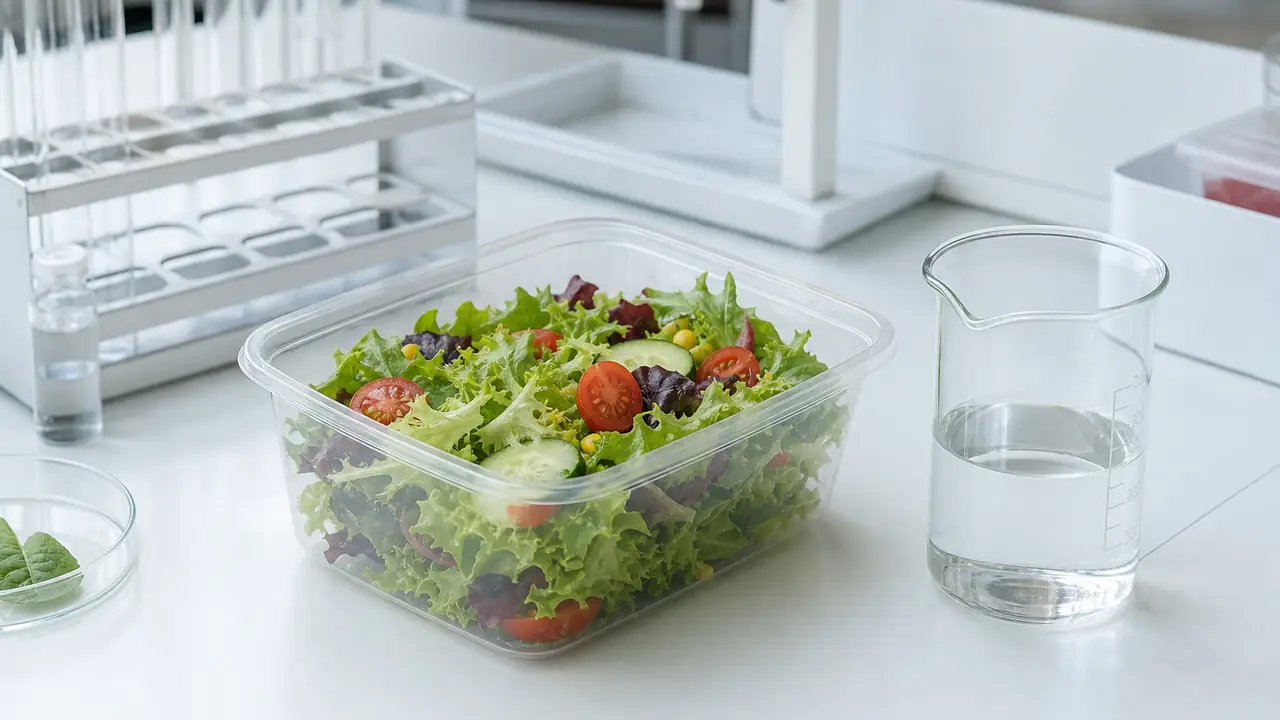
What counts as a food contact material
A food contact material is anything intended to touch food, or that can reasonably be expected to touch it in normal use. For a container program that means more than the base. The lid touches food when a box is tipped in a delivery bag. A divider insert sits inside the food. A printed sleeve may touch a bakery item through a window. A paper box carries grease from a pastry. Each part has its own material and each needs its own line in the specification.
The practical habit is simple: name the material of every part, then ask which of those parts touch food, at what temperature and for how long. A 750 ml PP box from a partner plant in Huizhou, 170x115x51 mm and 19.6 g, is one product on the price list and two food contact materials in the file, the base and the lid, which may come from different resin lots.
The materials buyers meet most often
Most of the containers in a food packaging range are made from a short list of materials. The list below sets out where each one fits and where it does not. The material guide covers the same ground line by line.
| Material | Resin code | Typical parts | Fits | Does not fit |
|---|---|---|---|---|
| PP | 5 | Takeout boxes, soup cups, bowls, divided trays, lids | Hot food, chilled storage, reheating where marked | Uses beyond the supplier temperature statement |
| PET | 1 | Clear clamshells, fruit boxes, cold cups and lids | Cold display, salads, fruit | Hot food and the microwave |
| PS | 6 | Clear organizers, some cold lids | Non-food storage, cold use per spec | Hot food |
| PVC | 3 | Gift box windows, clear folding boxes | Non-heated packaging and storage | Any food container, hot food, heating |
| Paperboard | None | Bakery boxes, click-lock boxes, pizza boxes | Dry, bakery and greasy food per coating | Liquids without a barrier |
| Starch-PP blend | Per spec | Cream coloured bowls and boxes | Rice bowls, meal sets per supplier statement | Compostable wording without certification |
PVC sits in the table for one reason: it shows up in the same orders, as the clear window on a kraft bakery box or a clear folding gift box. It is accepted there because the window is not heated and does not touch hot food. It is not used as a food container in this range.
Food contact grade is a declaration, not a label
Suppliers often describe a resin or a container as food grade. That phrase has no legal meaning on its own. What a buyer needs is a statement that the material complies with a named regulation for a named use, issued by the partner plant or the resin producer, and where required a test report from a third-party lab. The working wording on this site is made with food contact grade PP per supplier declaration, followed by the regulation and the conditions of use.
A resin producer's declaration covers the resin only. It is an intermediate document. The finished container adds colorants, sometimes recycled content, printing inks on the outside and the conditions of the molding process, so the finished item still needs to be checked against the rules of the market where it is sold.
The rules by market
In the United States, food contact substances fall under FDA rules in 21 CFR 174-178. Olefin polymers, including PP and PE, are covered by 21 CFR 177.1520, which sets specifications such as hexane extractables. Declarations usually name the conditions of use from the table in 21 CFR 176.170(c), graded A to H from high-temperature sterilisation down to room-temperature use. FDA does not approve finished containers, so the correct wording is compliant with 21 CFR per supplier declaration or test report.
In the European Union, the framework Regulation (EC) 1935/2004 applies to all food contact materials and Regulation (EU) 10/2011 to plastics. Plastics must stay within an overall migration limit of 10 mg/dm2, or 60 mg/kg of food simulant, plus specific migration limits for listed substances. German buyers may also ask for LFGB section 30 and 31 test reports and reference BfR recommendations. In China, GB 4806.1 sets general requirements, GB 4806.6 covers resins, GB 4806.7-2023 covers plastic materials and articles, and GB 4806.8 covers paper. The compliance guide sets out what to request for each.
Conditions of use decide the test
A material is never compliant in the abstract. It complies for a food type, a temperature and a contact time. A PP soup cup tested for hot fill and short-term reheating is a different case from the same cup used for chilled salad, and a PET fruit box tested for refrigerated storage says nothing about hot food. The supplier statement should name these conditions, and the migration test should match them. One partner plant states a working range of -10 to 120 C for its injection molded PP cups; that is a supplier statement, and the desk treats it as a starting point to be checked by test, not as a rating.
The same logic applies to marks molded into the part. A partner plant presses the PP code 5 and a microwave mark into the base of its export soup cups. The mark tells the end user what the supplier intends. It does not replace a heating check on the order sample. See microwave use and containers for how that check is set up.
What to ask a partner plant for
- The material of each part: base, lid, insert, window, sleeve.
- A declaration of compliance for the target market, naming the regulation and the conditions of use.
- Migration test reports from a third-party lab, matched to the food and temperature.
- For paper and fibre items going to the US, a statement on intentionally added PFAS.
- Traceability: resin grade and lot linked to the production batch.
The declaration of compliance guide sets out what a good declaration contains. Documents are issued to partner plants or to your brand per project; Lidwell does not hold certificates and verifies each document against the item and the order. Confirm market rules with your test lab or counsel.
Claims to keep off the packaging
Food contact rules sit next to marketing claims, and the two are often confused. Absolute words about toxicity or chemicals, or a claim that a regulator has approved the container, cannot be supported by a declaration or a test report and are not used on this site; FDA does not approve finished containers at all. A claim should say what was tested, to which rule, and under which conditions: tested to EU 10/2011 per report, microwave use per supplier marking with the lid removed where marked. That wording is narrower, and it holds up when a retailer or a market authority asks for the file.
Send the foods, temperatures and target markets through the quote form, and the desk returns matched reference models with the documents each market needs.