
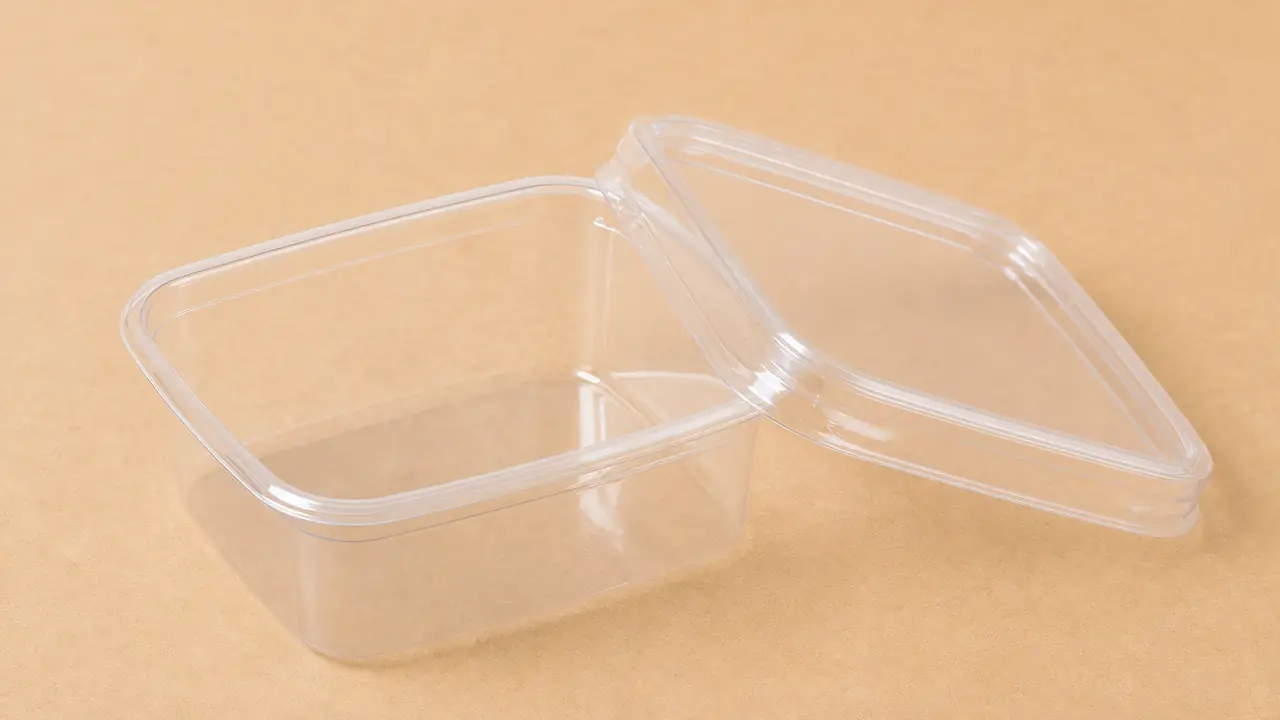
The three common looks
Partner plants in the Guangdong takeout cluster offer most PP container series in clear, in black base with a clear lid, and in white. Clear PP is slightly cloudy rather than glass-clear; it shows the food and is the default for most takeout and meal prep. Black base with a clear lid is common for hot meals and premium presentation, where the dark base frames the food and hides sauce marks. White suits dairy, desserts and some cuisines where a light background is traditional. Fully glass-clear containers are usually PET, used cold for salads, fruit and display.
What color changes: display and perception
Color is mostly about how the food looks and how the brand feels. A black base makes grilled meat, rice dishes and colorful vegetables stand out, and it makes the box look more substantial, which is why it is often chosen for higher-priced menus. A clear box shows the whole portion from every side, which helps in self-service fridges and meal prep where customers judge the portion before buying. White gives a clean, neutral look but shows stains from oily or colored sauces.
| Look | Usual material | Strength | Typical use |
|---|---|---|---|
| Clear PP | PP, natural | Shows the portion, hot use where marked | Takeout, meal prep |
| Black base, clear lid | PP with black colorant, PP lid | Frames hot food, hides marks | Hot meals, premium takeout |
| White | PP with white colorant | Neutral, clean | Desserts, dairy, some cuisines |
| Glass-clear | PET | Best clarity, cold only | Salads, fruit, display |
What color does not change: heat use
A black PP base and a clear PP base are the same polymer. Color does not make a container more or less suitable for hot food; the material and the supplier's marking do. A black base is often associated with hot meals, but that is presentation, not a technical rating. Heat and microwave use are stated per supplier marking on each model, usually with the lid removed or vented, and checked in a heating test on the sample. What matters more for heat is the lid: a black PP base with a clear PET lid is a cold-use set, because PET is not used hot. Check that a black-base set with a clear lid uses a PP lid if it is sold for hot food.
Colorants and food contact documents
Black, white and other colors come from masterbatch, a concentrate of pigment in a carrier resin that is blended with natural PP at the machine. For food contact, the colorant is part of the finished article, so declarations and migration reports should cover the colored version, not only the natural resin. For the US, the supplier declaration refers to FDA 21 CFR 177.1520 for the PP and should account for colorants used; for Europe, a declaration of compliance to EU 10/2011 for the finished article; for China, GB 4806.7. Documents are issued to partner plants or brands per project and verified by the desk. See food contact compliance guide.
Batch color consistency
Clear PP varies little between batches, though haze and slight yellowness can differ with resin lots. Colored bases need closer control: black usually holds well, but white and other colors can shift with masterbatch lot, dosing ratio and processing temperature, and the difference shows when old and new stock sit side by side on a shelf. The desk records a color reference on the approved sample and includes a visual comparison under agreed light at pre-shipment inspection. See color variation between batches.
Recycling and end of life
All three looks are PP, resin code 5, which is the code molded into the base of many partner plant containers alongside the microwave marking. Collection and sorting of PP containers depend on the local scheme, and some schemes handle dark-colored plastics differently from clear or white ones. If recycling claims are part of your packaging story, confirm how your target markets treat black and colored PP before choosing the color, and phrase any claim in line with local rules and the FTC Green Guides where they apply.
Storage boxes and organizers
For home storage the same logic applies with different weights. Clear boxes win on finding things at a glance: fridge bins, pantry boxes, shoe boxes and cosmetic organizers are mostly sold clear, in PET, PP, PS or acrylic. Opaque and colored boxes hide clutter in closets and under beds. Clear storage boxes show scratches and scuffs more, so packing and protective film matter; see scratches and scuffs on clear boxes.
Choosing by channel
The channel often settles the question faster than taste does. Restaurant takeout and delivery kitchens that serve hot dishes tend to choose black base with a clear PP lid for main courses and clear PP for sides and soups, so that the hero dish looks its best when the bag is opened. Meal prep brands usually prefer clear PP or black base on one footprint, because customers stack a week of meals in the fridge and want to see each portion. Supermarket produce and salad counters choose glass-clear PET for chilled display, where clarity sells and heat is not needed. Bakery and dessert lines often move to paper boxes with a clear PET or PVC window, which is acceptable because the window is not heated and does not touch hot food. See restaurant takeout for how kitchens build ranges.
Planning a range with color
- Use one look for the core menu, so stock and reorders stay simple.
- If both clear and black are needed, keep the same footprint and lid for both, so only bases differ.
- Confirm the lid material for any set sold for hot food.
- Ask for documents that cover the colored version.
- Record a color reference on the approved sample.
Stock molds in clear, black and white are available in the Guangdong cluster from a few mixed cartons; custom colors need a masterbatch match and usually a higher starting quantity, confirmed in writing per program. See MOQ and lead time and the PP food containers page, and send your menu through the quote form.