
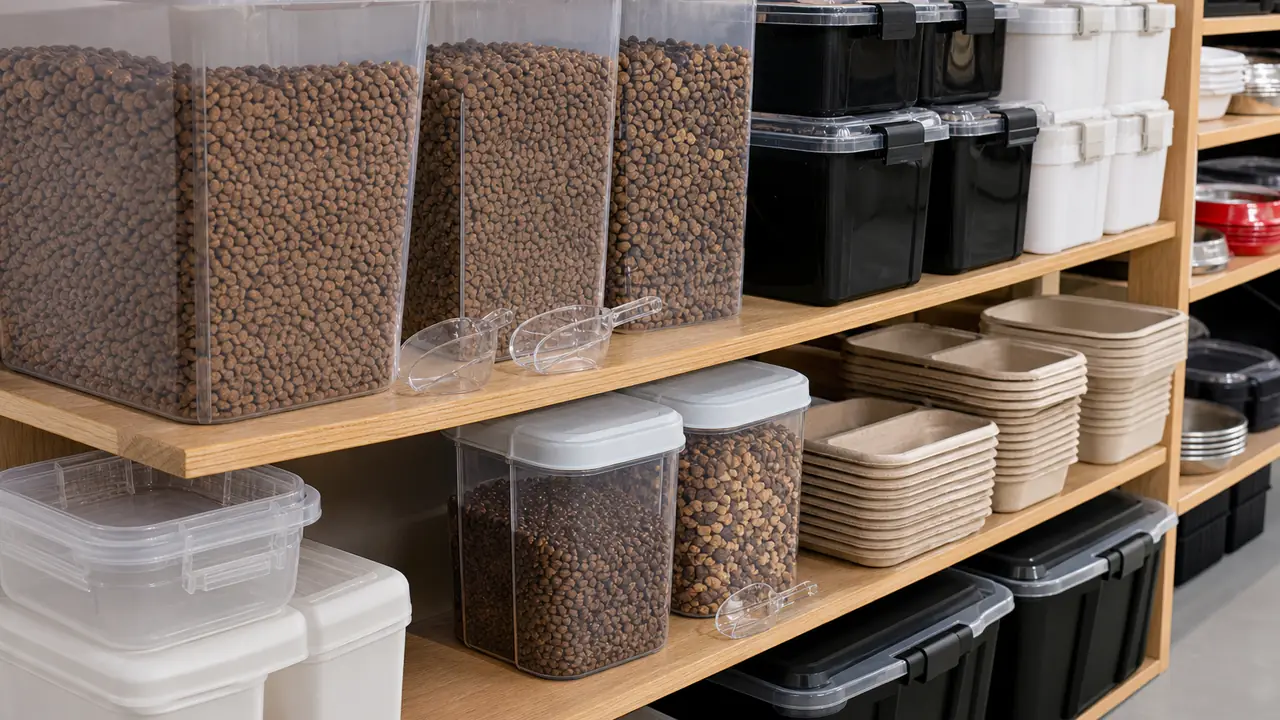
What a pet food container has to survive
Pet food bins are large, heavy and used every day. A full bin for a 20 lb bag of kibble is carried, rolled and lifted onto shelves; the lid is opened and closed once or twice a day for weeks until the bag is finished. The bin often stands in a garage, utility room or porch where temperature and humidity change, and it is meant to keep air, moisture and pests away from food that customers expect to stay fresh. Pets add their own test: a dog that noses the lid open or knocks the bin over.
The common failures follow from that use. A lid that does not seal lets food go stale and attracts insects. A latch or hinge cracks after repeated opening. Wheels snap off under load. A bin sold for a 30 lb bag turns out to hold less because kibble shape changes the volume. And thin walls bow outward when the bin is full, which breaks the seal line.
Recommended lines and materials
The pet food storage containers line uses PP or HDPE bodies with a sealing ring in the lid. PP is stiffer and gives a cleaner molded finish and better clarity in translucent versions; HDPE is tougher at low temperatures and suits bins kept in cold garages. Lids can be hinged, latched or screw-top on smaller treat jars. Typical features are wheels on larger bins, a measuring scoop that clips into the lid, and a front window or translucent body so owners can see the level. PVC is not used for these containers.
Smaller formats for treats and wet food leftovers overlap with the food storage lines, such as vacuum containers and reusable PP boxes. Large bins come from the injection molding cluster in Taizhou and Ningbo, Zhejiang, where large tools and the Huangyan mold makers are close together.
Reference sizes by bag weight
| Bag weight | Outer size | Metric equivalent | Note |
|---|---|---|---|
| 20 lb, 23 qt | 9.45x16.14x16.73 in | about 410x240x425 mm | Airtight lid |
| 25 lb | about 13.75x15.2x16 in | Per spec sheet | Upright bin |
| 30 lb | about 17.5x9.5x20 in | Per spec sheet | Slim, with wheels |
| 40 lb | about 21x12x17 in | Per spec sheet | Large, with wheels |
No partner plant reference model exists yet for this line, so sizes come from public listings as category references. Listings themselves note that capacity by bag weight varies with kibble shape, so the desk recommends a fill test with the actual food your customers buy before the bag weight appears on your packaging.
Checks the desk agrees per order
- Lid fit and opening force over repeated cycles, including latch and hinge.
- Seal check on the gasket and lid line with the bin full.
- Fill test with real kibble to confirm the stated bag weight.
- Drop test of the full bin and a roll test on wheels.
- Size, gram weight, wall check and odour against the approved sample.
- Outer carton stacking for transport.
- Print adhesion and rub on labels and lid print.
Counts and pass criteria are a stated working default, confirmed per order. The seal is described as airtight only to the extent the agreed test supports it, and never with an absolute claim.
Documents
Pet retailers increasingly ask for the same food contact paperwork they would ask for on kitchen containers: a supplier declaration for the PP or HDPE body to FDA 21 CFR 177.1520 for olefin polymers in the US, or to Regulation 1935/2004 and Regulation (EU) 10/2011 in the EU, plus a declaration for the gasket material. Whether the rules apply to animal feed contact in your market is a question for your test lab or counsel. Documents are issued to partner plants or to your brand per project and verified by the desk; see the compliance guide.
How to brief a pet retail program
- Give the bag weights you want to cover and the food type.
- Say where the bin will stand and whether it needs wheels.
- Choose lid type: hinged, latched or screw-top, and scoop or not.
- State colors, logo emboss and the retail pack you need.
- Give volume per size and the stores or channels you supply.
Send it through the quote form. Retail chains can also see retailers for shelf packaging and barcodes.