
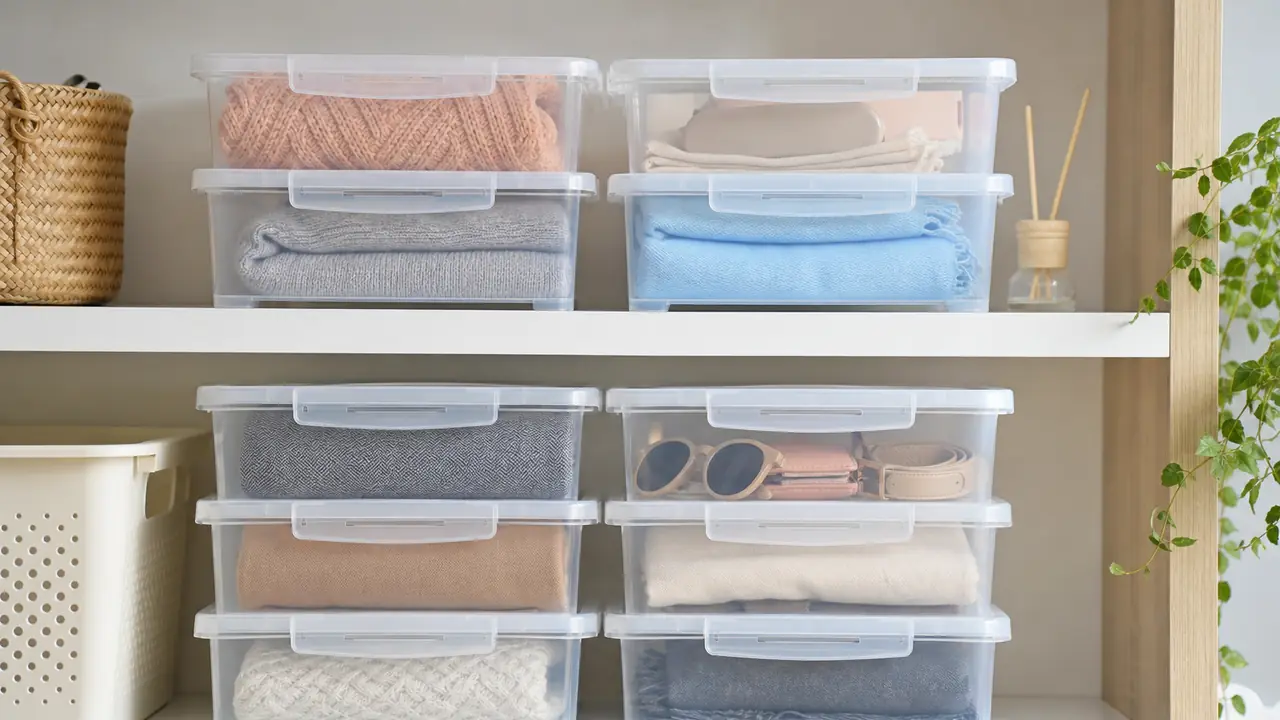
Why plan by room
A storage range planned by product type tends to grow sideways: three sizes of clear box, then four colours, then a lid variant, until the catalog is long and nothing obviously belongs together. A range planned by room starts from a place the customer recognises and asks what that place needs. The answer is usually a short list of formats that share materials, footprints and packaging style. It also gives the listing and the retail shelf a story, and it shows where a range has gaps before a competitor fills them.
Lidwell's home lines cover the main rooms. None has a partner plant reference model yet, so the sizes below are public listing reference sizes, used to describe the category and confirmed against a physical sample before an order.
The room map
| Room | Line | Reference size | Usual material |
|---|---|---|---|
| Kitchen, fridge | Fridge organizer bins | About 315 x 157 x 89 mm, sets of 8 | PET or PP |
| Kitchen, pantry | Vacuum food containers | 1.4 L about 233 x 156 x 90 mm; sets 0.5-2.0 L | PP or copolyester, silicone seal |
| Pet corner | Pet food storage containers | 20 lb about 410 x 240 x 425 mm | PP or HDPE, gasket |
| Bathroom, vanity | Cosmetic organizers | About 318 x 213 x 92 mm drawer unit | PS, acrylic, PET |
| Study, office | Desk organizer boxes | About 359 x 232 x 52 mm 7-compartment tray | PS, PP, acrylic |
| Closet, entryway | Shoe and clothes storage boxes | 330 x 230 x 140 mm folding shoe box | PP, PET, ABS with PP |
| Closet, garage, car | Collapsible storage boxes | 30 L about 440 x 330 x 230 mm, folds to about 47 mm | PP |
Kitchen and pantry
The kitchen is where storage meets food contact, and that changes the documents. Fridge bins and vacuum containers that hold food need supplier declarations to FDA 21 CFR or EU 10/2011 for each part, and a migration test report per project. Clarity sells in the fridge, so PET bins lead; seal and stiffness sell in the pantry, so vacuum containers in PP or copolyester follow. Food storage boxes are usually classified under HS 3924.10, to be confirmed with your customs broker. Read fridge organizer sizing before choosing bin sizes.
Bathroom and vanity
Vanity organizers are display products. They sit in view and are judged on clarity, finish and how they photograph. The material decision, PS for entry price, acrylic for premium, sets the price position of the whole sub-range. Drawer units and compartment trays should share a design language: the same corner radius, the same clear or frosted finish and the same packaging. Clear PVC appears here only as soft pouches and packaging. See cosmetic organizer materials.
Study and office
Desk organizers sell on layout. A standard drawer tray, a deep tray and a modular set cover most needs, and modular sets give bundles that are easy to price and photograph. If the range already has a vanity line in PS or acrylic, using the same material and finish for desk trays lets both share a look and sometimes a plant.
Closet, entryway and garage
Closets carry the volume of a storage range: shoe boxes, clothes boxes and folding crates. These are large, light products where freight decides much of the landed cost, so folding and nesting formats earn their place. Shoe boxes with front doors suit columns in an entryway; folding crates suit seasonal storage, garages and car boots. General storage boxes usually fall under HS 3924.90, confirmed with your customs broker. Sizing advice is in clothes storage box sizing.
Pet corner
Pet food bins are a natural extension for a kitchen or home range and often sell alongside bowls and scoops. They are large, so they need a carton plan early, and they carry a seal claim that has to be tested and described carefully. Capacity is best stated as a volume plus a weight range tested with a named kibble, since the weight a bin holds changes with kibble shape. Wheels and a scoop holder are the features that move a pet bin from a basic tub to a product customers recommend; see pet food containers.
One look across rooms
A room-based range only works as a brand if the rooms look related. Agree a small set of rules early and keep them across every line: two or three colours plus clear, one finish per material, the same corner radius on similar parts, one label position and one packaging style with the same carton print. These rules cost nothing at the design stage and are expensive to retrofit once molds and packaging are made. Record them in the program file so every plant works to the same rules.
Launch order and molds
Every new size is usually a new mold, so a range planned by room should also be planned by tooling. A practical launch order is:
- Start with the one or two rooms where your channel already sells, using stock molds where they fit.
- Pick one hero format per room and two or three sizes on a shared footprint.
- Fix a shared design language: colour, finish, corner radius and packaging style.
- Add custom molds only for the formats that differentiate the brand.
- Extend to the next room once reorder data shows which formats repeat.
Stock molds let a range launch with lower quantities and add a logo or packaging; custom molds give a distinct shape but add tooling time and higher starting quantities. The note on ODM vs OEM containers sets out the trade-off.
Quantities, plants and timing
Most home organizer lines come from injection molding plants in the household plastics clusters of Taizhou and Ningbo in Zhejiang. Taizhou counted more than 12,000 plastics producers in 2018, according to 2019 reporting on the China Trade Remedies Information website, so a range can usually be split across plants that specialise in each format, with the desk keeping one specification, one inspection plan and one consolidated shipment. Storage lines typically start from 1,000-3,000 pieces per item, depending on size and mold; stock items typically ship in 7-15 days, custom work in 15-30 days and new molds in 45-60 days for the first order including tooling. These are typical reference ranges, confirmed in writing for each program on MOQ and lead time. Send your rooms, channels and target launch date through the quote form.