
From flat sheet to folding box
A folding box is designed flat. The dieline is the drawing of that flat shape: the outline that will be cut, the lines that will be creased so the board folds, the glue flaps, and any window opening. Printing is laid out on the same sheet, so artwork and dieline are made together. After printing, the sheet goes through a die cutter, which cuts and creases in one stroke; then waste is stripped, windows are patched where needed, and the blanks are folded and glued on a gluing line, or shipped flat for the user to fold.
Paper boxes and printing cluster around Longgang near Wenzhou, which received the China printing town title in 2002; press reporting in 2024 put its printing and packaging output at about 20 billion yuan and counted 894 licensed printing enterprises. The desk works with partner plants there for gift and bakery boxes and printed sleeves; see industry clusters.
Reading a dieline
| Line | What it means | What to check |
|---|---|---|
| Cut line | The die cuts fully through the board | Outer size, window opening, tuck tab shape |
| Crease line | The board is pressed so it folds along a line | Every fold has a crease; creases run on the correct side |
| Perforation or tear line | Partial cuts for opening or display | Holds in transit, tears cleanly in use |
| Glue area | Where flaps are glued on the gluing line | No print or coating that blocks the glue |
| Bleed | Print extended past the cut line | Enough bleed so no white edge shows after cutting |
| Window opening | Cut-out patched with clear film | Film overlap and glue margin around the opening |
A dieline should also state the board, the side that is printed, and the inside dimensions of the finished box. Outer and inner sizes differ by the board thickness at each wall, which matters when a box must hold a fixed product such as a cake tray or a set of containers.
Board, grain and creasing
Paperboard has a grain: its fibres lie mostly in one direction. Board folds more cleanly across the grain on some panels and resists bending better along it on others, so the plant lays out the blanks on the sheet with the grain set for the box design. A box laid out against the grain can bow, crack at the fold or fail to stand square.
Creasing is done by a blunt steel rule in the die that presses the board into a channel in a matrix on the other side. The rule height, the channel width and the board caliper have to match. Too shallow a crease and the box fights the fold; too deep and the board cracks, especially on coated white card or printed solids, where the ink or coating breaks along the fold. Kraft board, white card and white card with a foil lining each behave differently here. The board grades themselves are covered in paperboard grades for gift boxes.
The die and the cutting line
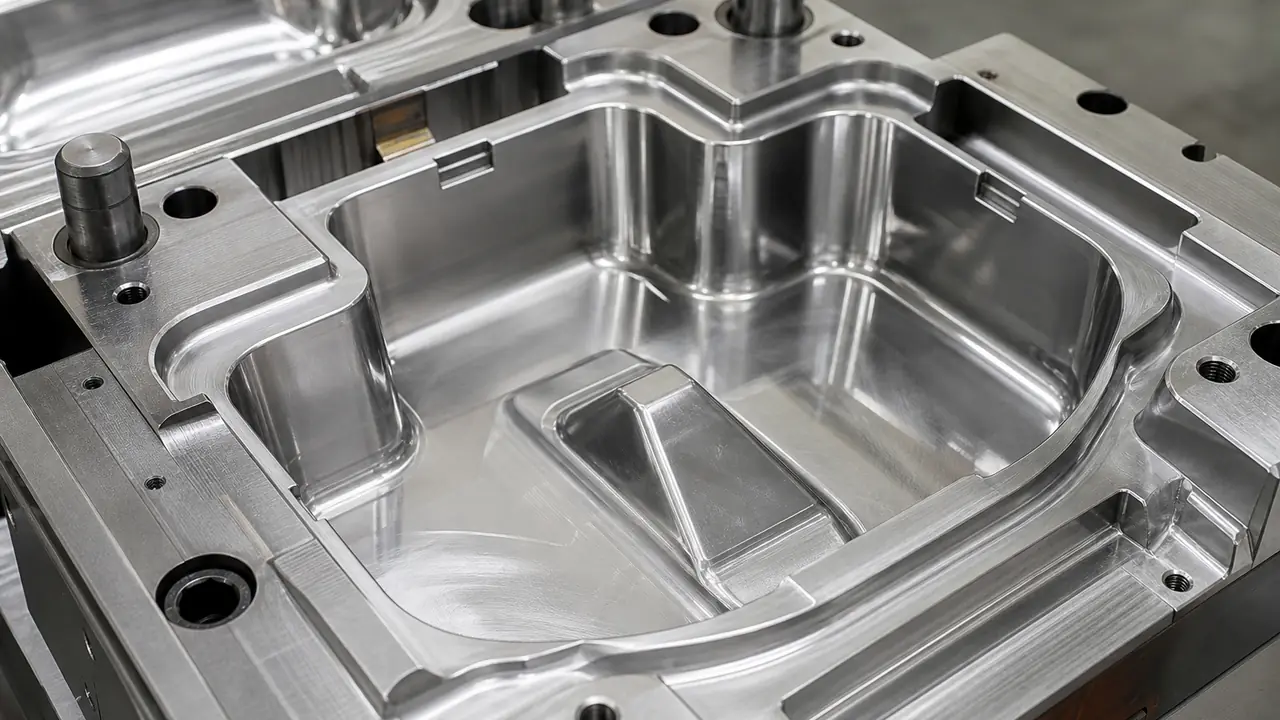
The cutting die is a board with steel rules set into it along the cut and crease lines, with rubber around the cutting rules to push the board out after each stroke. Flatbed die cutters press the whole sheet at once and suit most gift and bakery boxes; rotary cutting suits very long runs. The die is a custom tool for each dieline, so a new box shape means a new die, while new artwork on an existing dieline does not. That is one reason buyers are advised to settle the box structure early and vary the print rather than the shape.
Windows: PET or PVC film
Bakery and gift boxes often have a clear window or a clear lid. After die cutting, a window patching machine glues a piece of clear film over the opening on the inside of the blank. The film can be PET or PVC. Both are acceptable in this use because the window is not heated and does not touch hot food, which is the only place PVC appears in this range. A reference kraft bakery box from a partner paper plant takes a clear lid and comes in a large 190x85 mm size, 35 mm high, a medium 160x85x35 mm and a small 135x73x35 mm. Where a window may touch food directly, such as a dessert box, the film choice and its declaration are agreed per project. The wider material picture is in where PVC belongs in packaging.
Gluing and box styles
Gluing turns the blank into a box the user can open in one movement. A straight-line glued box has one side seam glued and folds flat; a crash-lock bottom box has a pre-glued base that locks when the box is opened, which is faster to set up on a busy counter. Click-lock takeout boxes, which a partner plant makes from 350 to 2,880 ml in kraft, white card and white card with foil lining, lock by their tabs and may need no glue at all. Pizza boxes from 6 to 12 inches are another flat-shipped style. See folding gift boxes.
Food contact and fibre rules
Paper boxes that hold food have their own rules. In China, GB 4806.8 covers paper and board food contact materials. In the US, many states restrict intentionally added PFAS in plant fibre food packaging, with California AB 1200 in force since 1 January 2023, so buyers ask for a PFAS statement covering board and coatings. Grease resistance therefore comes from board choice, foil lining or a non-fluorinated coating, confirmed per project. Confirm market rules with your test lab or counsel.
Checks and order quantities
- Approve the dieline with inner and outer dimensions and the board grade.
- Approve print proofs on the dieline, with bleed and glue areas clear.
- Fold hand-cut blanks, then a production sample, including the window.
- Agree burst and edge crush checks for the board, print rub and outer carton stacking, confirmed per order.
Printed paper boxes typically start at 5,000-10,000 per design, with printed samples in about 7-15 working days and printed batches in about 15-30 days, confirmed in writing per program. See MOQ and lead time and send the box size and artwork through the quote form.